

As parents, we are navigating an era that no previous generation ever had to face. Our children are growing up in a hyper-digital, instantly gratified world. Entertainment, social validation, and gaming achievements are all accessible at the swipe of a touchscreen. While technology offers incredible educational tools, it has also introduced unprecedented challenges for parents trying to raise focused, healthy, and resilient children.
Many parents notice that prolonged screen time often leads to shortened attention spans, physical restlessness, and difficulty handling face-to-face social dynamics. If you find yourself constantly battling over device boundaries or noticing your child struggles to stay focused on tasks, you are not alone.
The solution isn’t simply removing technology; it’s about providing a compelling, structured counterweight. That is why families are turning to martial arts classes in Clemson. Traditional martial arts training offers a comprehensive physical and mental structure that a digital screen simply cannot replicate.
The Screen-Time Dilemma: What Modern Kids Are Missing
When children spend hours engaging with tablets, video games, and streaming platforms, their brains are flooded with rapid-fire dopamine hits. Every level cleared, video watched, or notification received trains their minds to expect immediate rewards with minimal physical or mental effort.
This continuous digital stimulation can lead to noticeable gaps in a child’s foundational development:
- Decreased Physical Literacy: Core strength, balance, and bilateral coordination are built through varied, dynamic movement. Sedentary screen time deprives developing bodies of these crucial motor skills.
- Fragmented Attention Spans: When entertainment moves at the speed of a high-speed internet connection, sitting still and listening to an instructor or school teacher feels incredibly difficult.
- Low Frustration Tolerance: In a video game, if you fail, you press “restart” immediately. In the real world, overcoming obstacles requires patience, physical effort, and emotional regulation.
Traditional martial arts training addresses these specific modern dilemmas by taking children off the couch and placing them into an environment built on deliberate movement, incremental progress, and foundational respect.
1. Replacing Passive Entertainment with Active Physical Literacy
One of the most immediate benefits of enrolling your child in martial arts classes in Clemson is the profound impact on their physical health. Unlike modern school sports, which can sometimes favor naturally gifted natural athletes while leaving others on the bench, traditional martial arts provides an individualized journey within a structured group environment. Every single child is actively participating on the floor for the entire duration of the class.
Traditional martial arts instruction focuses heavily on functional movement patterns. Students learn:
Bilateral Coordination: Executing blocks, stances, and traditional kicks forces the left and right hemispheres of the brain to coordinate seamlessly, significantly improving general athleticism.
Spatial and Body Awareness: Children learn exactly how their bodies move through space, which directly reduces clumsiness and increases confidence on the playground.
Core Strength and Posture: Hours spent slouching over devices can weaken a child’s core and shoulder muscles. The upright, deliberate stances of martial arts naturally correct posture and build functional, full-body strength.
2. Cultivating Unshakeable Focus in a Distracted World
In our studio, we practice a concept known as the 3-Step Focus Rule: locking the eyes, locking the mind, and locking the body onto the task at hand.
When a child steps onto the martial arts floor, the digital noise evaporates. There are no screens, no notifications, and no background distractions. The environment is clean, quiet, and highly focused.
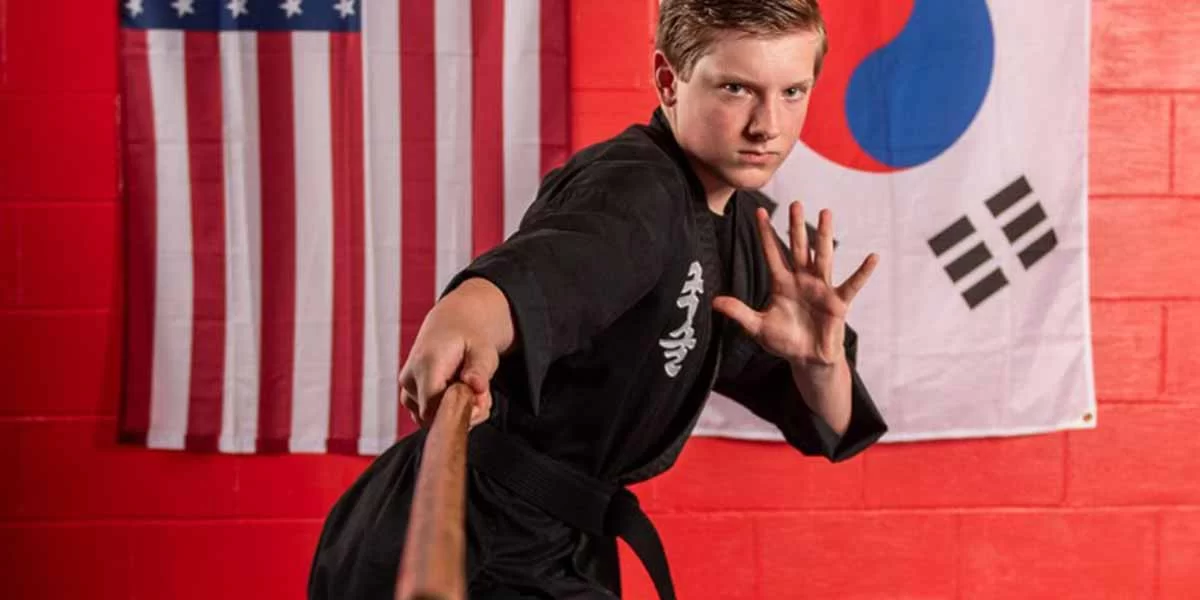
Through the repetition of traditional forms (known as Hyung), children learn the art of deliberate practice. They discover that to execute a perfect martial arts block or kick, they must quiet their minds and concentrate entirely on their alignment, balance, and breath. This practice actively re-trains a child’s brain to sustain focus for extended periods—a skill that transfers directly to their performance in local Clemson classrooms, homework completion, and chores at home.
3. The Belt System: Teaching True Resilience and Long-Term Goal Setting
In a video game, “leveling up” can happen in an afternoon of button-mashing. In traditional martial arts, earning a new belt stripe or a new belt color takes weeks of consistent effort, sweat, and focused practice.
The belt ranking system is one of the most effective tools for teaching children the value of long-term goal setting and delayed gratification. When a student enters the martial arts school, they quickly realize that a belt isn’t just handed out; it must be earned.
This journey teaches children how to navigate failure constructively. If a student tries a complex kick or form and falls down, the instructor doesn’t reset the game. The instructor helps them stand up, adjust their stance, and try again. By experiencing the direct correlation between consistent practice and tangible reward, children build a deep, internal resilience. They learn to view challenges not as permanent roadblocks, but as temporary puzzles waiting to be solved with effort.
4. Instilling Restraint, Courteous Behavior, and Mutual Respect
A common misconception among parents who haven’t experienced a traditional martial arts school is that the training might encourage aggressive behavior or fighting. In reality, the exact opposite is true. True martial arts instruction places an absolute premium on character development, courtesy, and self-restraint.
From the very first day, students are immersed in an atmosphere of respect:
-
The Bow: Students bow when entering the floor, to their instructors, and to their training partners. This is a physical reminder that everyone on the mat is valued and respected.
-
Controlled Technique: Students are taught from day one that their martial arts skills are strictly for self-defense and personal development, never for showing off or picking fights.
-
Conflict Minimization: True martial arts confidence actually de-escalates conflict. When a child carries themselves with strong posture, clear eye contact, and an unshakeable sense of self-worth, they rarely become targets for bullying. They possess the quiet confidence that allows them to walk away from a verbal confrontation without needing to prove themselves.
Beyond the Mat: Bringing the Structure Home
The ultimate goal of traditional martial arts training is not just to build excellent martial artists inside the studio, but to help parents raise exceptional human beings out in the world. The values practiced on our floor—focus, discipline, respect, and perseverance—are deliberately bridged by our instructors to apply to life at home and at school.
When a child learns to stand perfectly still in a martial arts stance, they are learning self-control. When they push through a difficult training session, they are learning perseverance. When they bow to a senior instructor, they are practicing courtesy. These habits gradually replace the restless, immediate-gratification mindsets cultivated by excessive device use.
About the author : Clemson Martial Arts

Founded in 2009 by Sarah and Toran Gordinier, who have both practiced martial arts for over 20 years and have a commitment to share their passion with students of all ages. Clemson Martial Arts is trade name of Upstate Holistic Health, LLC.
More Articles from Clemson Martial Arts

Featured Programs

More Posts

Perseverance: The Skill That Matters More Than Talent
By Master Sarah & SBN Toran Every parent wants to help their child succeed. Many people assume success comes from being naturally gifted or exceptionally intelligent. While those qualities can certainly help, research consistently points [...]
The 3-Step Focus Rule: How to Increase Child Focus and Self-Control
Ask any parent of a 6- to 8-year-old about their daily challenges, and a familiar theme will almost always emerge: the battle for focus. In early elementary school, children are bombarded with distractions—from classroom chatter [...]

Leaving Work on the Mat: Using Traditional Forms and Breathing to Physically Release Chronic Stress
You know the feeling. You log off for the day, close your laptop, or walk out of the office, but your brain hasn’t actually left. Your shoulders are up around your ears, your mind is [...]
