
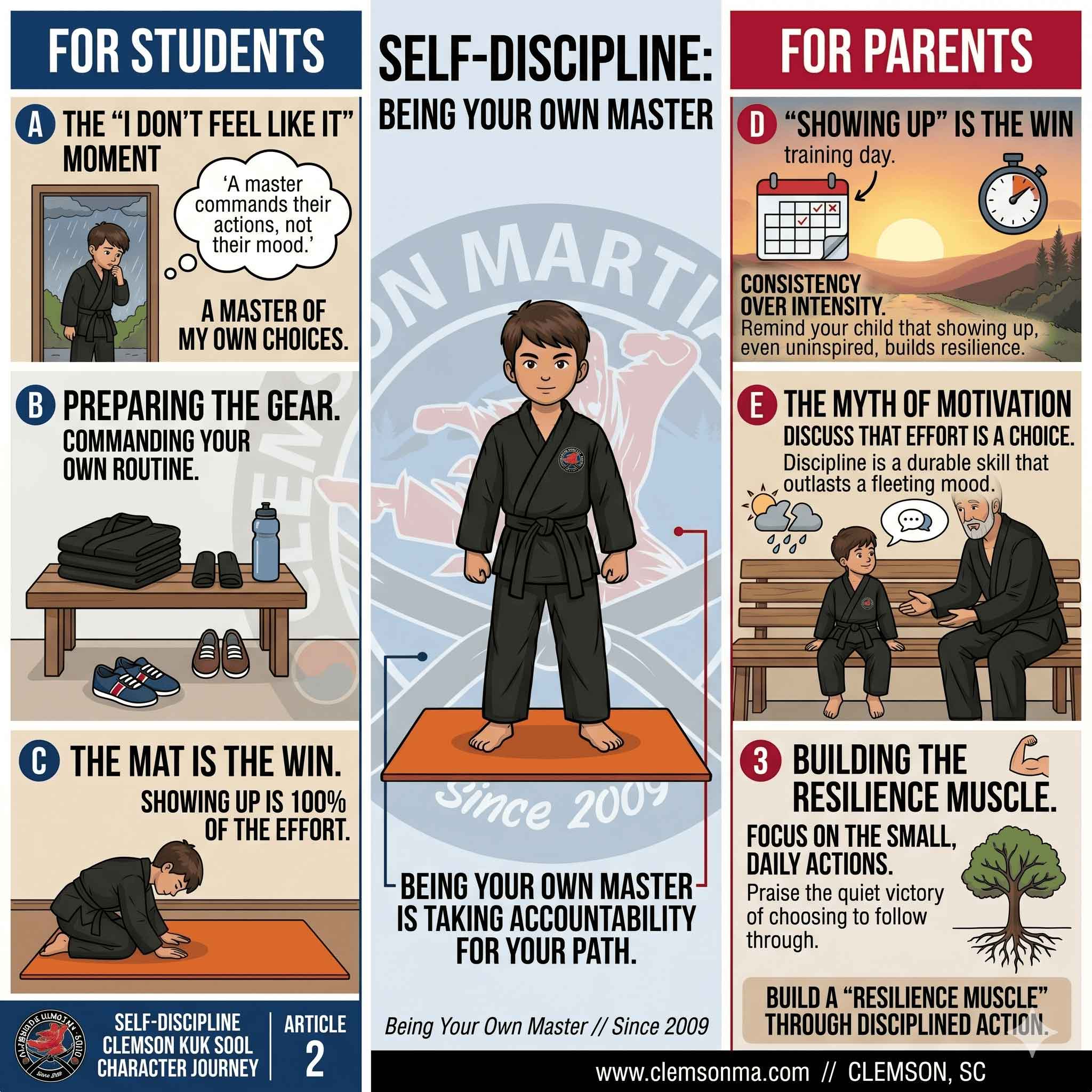
As we transition from the discipline of February’s “Respect” into the fresh energy of March, our focus at Clemson Martial Arts shifts to a virtue that is often misunderstood, yet foundational to true mastery: Humility.
In the traditional Korean martial art of Kuk Sool, humility isn’t about weakness or a lack of confidence. Rather, it is the “Quiet Strength”—the ability to remain open, teachable, and grounded, regardless of how many stripes are on your belt or trophies are on your shelf. For our students (and for us as parents), humility is the soil in which all other virtues grow.
The “Empty Cup” Philosophy
In martial arts, we often speak of the “Empty Cup.” If a cup is already full, it cannot receive any more water. Similarly, if a student enters the dojang believing they already know everything, their progress stalls.
Humility allows a practitioner to:
-
Accept Correction: Seeing a physical adjustment from an instructor not as a critique, but as a gift.
-
Value Every Partner: Understanding that you can learn as much from a white belt’s raw determination as you can from a black belt’s refined technique.
-
Check the Ego at the Door: Recognizing that the goal is self-improvement, not proving superiority over others.
Bringing Humility Home: Practical Lessons for Parents
It can be tempting to focus solely on our children’s “wins,” but the most profound growth often happens in the moments that require humility. Here is how you can help your child apply this principle to their training and their daily life:
1. Celebrate the Effort, Not Just the Rank
When your child struggles with a complex hyung (form) or a difficult break-fall, highlight their perseverance.
-
The Takeaway: Remind them that being a “beginner” at a new skill is a brave and necessary state. Humility is having the courage to be “bad” at something until you are good at it.
2. Model “Teachable Moments”
Children watch how we handle our own mistakes. When you make an error at home or work, admit it openly.
-
The Takeaway: Show them that apologizing or asking for help isn’t a sign of failure—it’s a sign of maturity. In Kuk Sool, we bow to show that we value the person in front of us more than our own pride.
3. Practice “Silent Service”
In many traditional schools, higher ranks help clean the mats or organize gear without being asked. This is humility in action.
-
The Takeaway: Encourage your child to do one “silent” chore at home this month—something helpful that they don’t seek praise for. This builds the habit of doing the right thing for its own sake, not for an audience.
The Martial Arts Paradox
The paradox of Kuk Sool is that the more skilled you become, the more humble you should appear. A true master has nothing to prove and everything to share. By fostering humility this March, we aren’t just making better martial artists; we are raising leaders who lead with empathy and a lifelong hunger for learning.
“A valley is deep because it is humble; because it is low, all the rivers flow into it.”
March Challenge: The “Still Learning” Mindset
This month, ask your child after class: “What is one thing you learned today that you didn’t know before?” By focusing on the learning rather than the performing, we keep their “cups” empty and ready for the next drop of wisdom.
About the author : Clemson Martial Arts

More Articles from Clemson Martial Arts

Featured Programs


More Posts
Perseverance: The Skill That Matters More Than Talent
By Master Sarah & SBN Toran Every parent wants to help their child succeed. Many people assume success comes from being naturally gifted or exceptionally intelligent. While those qualities can certainly help, research consistently points [...]
The 3-Step Focus Rule: How to Increase Child Focus and Self-Control
Ask any parent of a 6- to 8-year-old about their daily challenges, and a familiar theme will almost always emerge: the battle for focus. In early elementary school, children are bombarded with distractions—from classroom chatter [...]

Leaving Work on the Mat: Using Traditional Forms and Breathing to Physically Release Chronic Stress
You know the feeling. You log off for the day, close your laptop, or walk out of the office, but your brain hasn’t actually left. Your shoulders are up around your ears, your mind is [...]
