
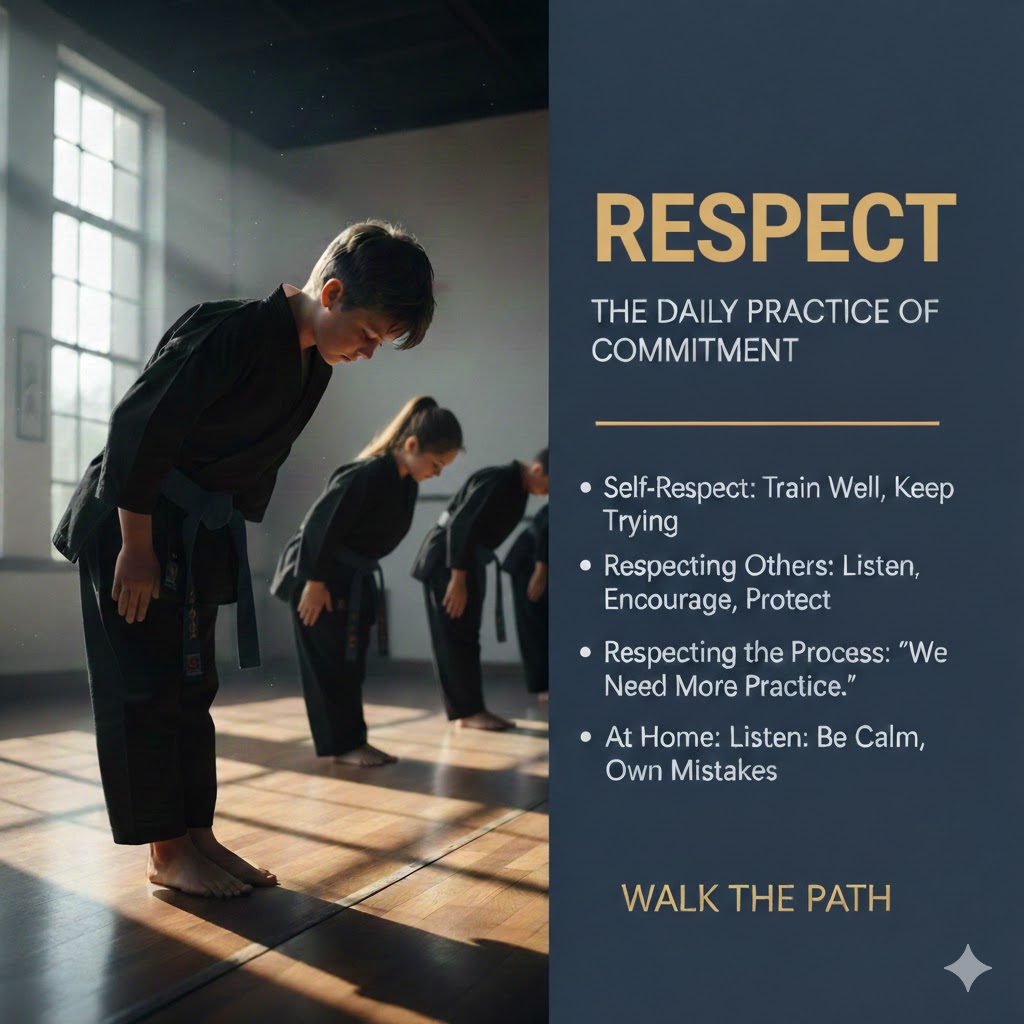
In January, we focused on Commitment—the discipline of showing up, taking small steps, and starting again when things don’t go perfectly. February builds directly on that idea by answering an important question:
What does commitment actually look like in daily behavior?
In martial arts, the answer is Respect.
Respect isn’t just a rule we follow or a word we say. It’s the way commitment shows up in our actions—toward ourselves, our instructors, our training partners, and our families.
Respect begins with self-respect.
A committed student doesn’t rush through class or give half effort. They take care of their uniform, listen to instruction, and try again when something is difficult. Self-respect is choosing to train well even when motivation is low. It’s understanding that improvement takes time and honoring the process enough to stay engaged.
This connects directly to one of our most important training phrases: “We need more practice.”
Saying that phrase is an act of respect. It means we believe effort matters. It means we’re committed to growth instead of judging ourselves for not being perfect. A student who respects themselves doesn’t quit when things get hard—they reset and continue.
From there, respect extends outward to others.
Respecting instructors means listening carefully and responding promptly. Respecting training partners means practicing control, offering encouragement, and keeping each other safe. These behaviors aren’t automatic—they’re a choice. And that choice is rooted in commitment to the group, the class, and the learning environment.
Bowing in and out of class is a physical reminder of that commitment. It asks students to slow down, focus, and acknowledge the people they’re training with. It’s not about tradition alone—it’s about awareness and intention.
Respect also shows up when things don’t go well.
A committed martial artist doesn’t throw their belt, blame others, or shut down. They pause, reset, and try again. That response builds emotional control and maturity—skills that matter just as much at home and school as they do on the mat.
At home, respect looks similar:
- Listening the first time
- Using calm tone
- Taking responsibility for mistakes
- Treating others with dignity, even when frustrated
These behaviors grow when adults model them and notice them:
- “I saw you reset and try again.”
- “Thank you for listening.”
- “That showed real commitment.”
- Commitment is the decision to stay on the path.
- Respect is how we walk it—every day, in small, consistent ways.
And every time your child bows in, listens, adjusts, and continues, they’re practicing both.
About the author : Clemson Martial Arts

More Articles from Clemson Martial Arts


Featured Programs
More Posts

Perseverance: The Skill That Matters More Than Talent
By Master Sarah & SBN Toran Every parent wants to help their child succeed. Many people assume success comes from being naturally gifted or exceptionally intelligent. While those qualities can certainly help, research consistently points [...]
The 3-Step Focus Rule: How to Increase Child Focus and Self-Control
Ask any parent of a 6- to 8-year-old about their daily challenges, and a familiar theme will almost always emerge: the battle for focus. In early elementary school, children are bombarded with distractions—from classroom chatter [...]

Leaving Work on the Mat: Using Traditional Forms and Breathing to Physically Release Chronic Stress
You know the feeling. You log off for the day, close your laptop, or walk out of the office, but your brain hasn’t actually left. Your shoulders are up around your ears, your mind is [...]
